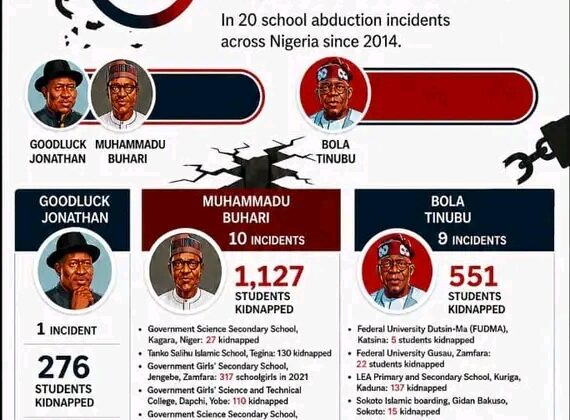
Nigeria’s Insecurity Crisis: A Catastrophe of Kidnapping, Impunity, and Moral Neglect
Nigeria’s Insecurity Crisis: A Catastrophe of Kidnapping, Impunity, and Moral Neglect
By✍️Hon. Martha Zamani Musa(MHR)
Date; 06/06/2026.
When 1,954 students were abducted from schools in only 20 incidents, Nigeria can no longer hide behind statistics. This is not “security discourse.” It is a national indictment, of systems that have failed, of intelligence that has been ignored, and of leadership that treats the kidnapping of innocent children and civilians as though it were an unfortunate inconvenience rather than an assault on the soul of the nation.
Behind every number is a stolen childhood. Behind every headline is a traumatized family. Behind every abduction is a country watching itself collapse in real time.
_The Nigeria We Are Quietly Losing: Schools Turned into Hunting Grounds:_
Education is supposed to be the safest investment a nation can make, because it produces the future. Yet in Nigeria today, schools are increasingly transformed into predatory zones, where criminals hunt children with impunity and the state responds too late, too weakly, and too inconsistently.
When children are kidnapped from classrooms, the crisis is not merely “insecurity.” It is governance failure. It is proof that protection, especially for children, is not guaranteed by the institutions that exist to protect.
A nation that cannot secure its classrooms cannot credibly claim it is securing its development agenda. A nation that cannot defend its children is mortgaging tomorrow with today’s failure.
_Kidnapping as National Normalization: Condolences Without Consequences_
The most devastating element of this tragedy is not only the abductions, it is the normalization of them.
We react with grief. We issue statements. We promise investigations. We mourn publicly and move on privately. And while Nigerians are still trying to digest one tragedy, another set of children is being taken, because nothing fundamental changes.
This is the pattern of a system addicted to sympathy but resistant to accountability. Outrage that expires after a news cycle is not patriotism, it is complicity through silence.
_The Most Sacred Failure: When Leadership Refuses to Defend Innocence_
Every government has a constitutional and moral obligation: to protect lives and property. That obligation becomes most urgent where the victims are the defenseless, children, mothers, fathers, and ordinary civilians, who did not choose danger.
But what Nigerians are witnessing, at the Presidency, within the national security architecture, and across the National Assembly is a recurring picture of dangerous indifference, scavenging opportunism from the very people elected and appointed to stop terror, coupled with a political culture that does not treat kidnappings as existential threats.
Insecurity on this scale is not an accident. It is a warning. And a warning ignored becomes a verdict on leadership.
_Terrorism and Kidnapping Are Not “Separate” Issues. They Are One War Against Nigeria’s Future_
Kidnapping is not an isolated crime; it is an instrument of terrorist, used to weaken communities, intimidate parents, disrupt learning, and finance further violence. When criminals can abduct students, it means they can also plan, recruit, transport, and escape. That requires capacity, and capacity requires oversight failure and intelligence breakdown.
Therefore, Nigeria must confront the reality of the terrorism spree as a coordinated national security emergency—not a rotating regional problem to be managed until it suits political timing.
_The Dangerous Ignorance of Inaction: Intelligence Without Action Is Folly_
A nation cannot claim to be serious about security while intelligence gathering is treated as theatre and response is treated as improvisation.
If school abductions occur repeatedly, then the question is not whether threats exist. The question is whether leadership has demonstrated the competence, urgency, and will to eliminate them.
Security requires:
-Real-time threat interdiction,
-Accountable policing and rapid deployment,
-Effective border control and counter-criminal financing,
-Protective operations around vulnerable schools,
-Transparent, measurable outcomes, not ceremonial declarations.
Where those fundamentals fail, innocence becomes expendable, and that is an indictment no nation should accept.
_A Nation Built on Fear Cannot Produce a Future_
Every kidnapped child represents a broken life plan:
-A dream interrupted,
-A family shattered,
-A community traumatized,
-A generation pushed toward hopelessness
_Nigeria cannot keep exchanging childhoods for temporary political survival._
When the state cannot protect children, every other investment, economy, infrastructure, reform, becomes meaningless, because the foundation of national progress is human security.
_A Heartbreaking Conclusion. History Will Judge Us by What We Did, Not What We Said_
History will not remember condolence messages as justice. It will not honor promises that never mature into decisive action. It will judge Nigeria by whether leadership created a society where children can return home safely after school.
Until kidnappers are deterred decisively, until communities are protected consistently, and until accountability becomes unavoidable, Nigeria remains in moral crisis.
This is not only insecurity. It is a national tragedy with preventable causes, and preventable suffering.
Carefully Written by✍️Hon. Martha Zamani Musa (MHR),
Eti-Osa Federal Constituency.